
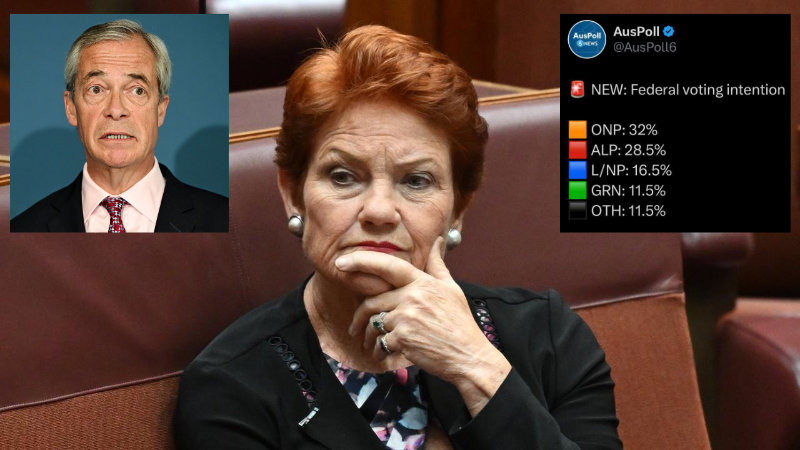
Pauline Hanson’s One Nation won the Farrer by-election last week, while Nigel Farage’s Reform UK trashed the British Labour Party in local council elections. What’s behind it? Aleta Moriarty asks.
The Farrer by-election result and Reform UK’s stunning win both reflect growing frustration with mainstream politics, soaring inequality and a distrust of institutions, being captured by the populist right, and perhaps paving the way for autocracy.
For the first time in more than two decades, the world has more autocracies than democracies. According to the V-Dem Democracy Report 2026, 91 autocracies now outnumber 88 democracies, 72% of the world’s population living under authoritarian rule.
V-Dem identifies media censorship as the single most common tool of democratic erosion globally, followed by the undermining of elections and civil society. Disinformation is now spreading in nearly half of all autocratising countries. Much of the decline is happening inside nominally democratic states, through executive overreach, judicial packing, the criminalisation of dissent, and the weaponisation of national security laws against journalists and political opponents.
This was one of the themes at the recent Women Deliver conference in Melbourne, where I spoke with two of the world’s leading human rights experts, Dr Agnes Callamard, Secretary-General of Amnesty International and Kate Gilmore, former United Nations Deputy High Commissioner for Human Rights, about what they thought was going on.
State capture and ‘Big Tech’
Both human rights experts believe large corporations, particularly Big Tech, are underpinning the rise of populism and authoritarianism. This, coupled with genuine grievance generated through soaring economic inequality, has created the perfect storm.
Gilmore points to a parallel failure of the algorithmic dismantling of public opinion. She argues that democracy is far more than the ballot box, encompassing an independent judiciary, a diverse media landscape, civilian policing, the primacy of fact over fiction, respect for science, and academic freedom. All of it, she said, is under threat and has been eroded.
“The bridge between polity and autocracy is a business model based on clickbait algorithms that are driving these very phenomena (where)
there is this tiny handful of people who’ve become obscenely wealthy at the expense to us.
Mining magnate Gina Rinehart’s relationship with One Nation is emblematic: she gifted the party a $2.1m Cirrus G7 aircraft alongside $2m in further donations, while Australian billionaires on average increased their wealth by $600,000 a day; she is hardly a champion for the working class or their interests.
“There is no doubt the Social Contract has broken, “ said Gilmore in explaining how extreme inequality and the unfounded premise that a rising tide would lift all ships are helping to drive this, “It is a contest between capital and democracy, between inequality and calls for equality. Stand up. Speak out. Defend the fundamental human rights that create and cause us to be the same human family.”
Predators at the gate
Dr Agnes Callamard, Secretary-General of Amnesty International and one of the world’s foremost authorities on accountability and international law, does not mince words about what is driving the rollback on rights and law and order globally.
“The predators are Donald Trump, Benjamin Netanyahu and Vladimir Putin. They do not hesitate to say the law does not apply to them, that international rules constructed over the last eighty years do not apply to us,” she said. “They are entitled to replace diplomacy with war. They are entitled to invade other countries’ territory and claim it with pride.
They are entitled to normalise violence against civilians.
What makes this moment different, Callamard argues, is not merely that these leaders violate international and domestic norms, but that they want these norms dead, via defunding, sanctions and attack, destabilising the rules-based order. They have also offered a franchise, a blueprint, for others to harness popular grievances to drive an autocratic agenda for self-serving billionaires. And that is why it is important to draw boundaries and speak up in the face of such transgressions.
Rising inequality, falling trust
The 2025 Edelman Trust Barometer shows national trust falling to just 49%, with 59% believing leaders deliberately mislead the public. Inequality is higher now than in 2002, and OECD PISA data confirm Australia has one of the most unequal school systems in the developed world. That inequality is increasing, with achievement gaps between private and public schools widening since 2006.
A majority of Australians surveyed by ACOSS believe government policies have pushed people into poverty.
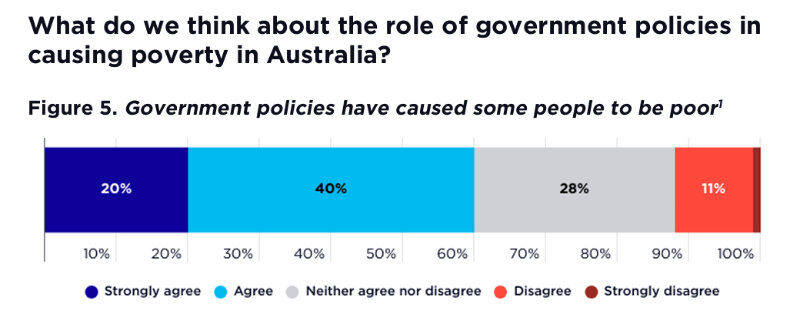
Source: ACOSS
We have expanded cost of living in everything from housing, the most often talked about, to every other aspect of society. University arts degrees now cost over $50,000, with student contributions nine times higher than 35 years ago in some disciplines.
The Australia Institute indicates Australia now has the most expensive secondary education in the developed world. We have privatised basic services and eroded public provision to such an extreme degree, while simultaneously expecting wage workers to carry a disproportionate share of the tax burden.
The protest vote
A recent AusPoll shows PHON is now the major party in Australia.
I analysed a post on One Nation voters on the words they associated with Pauline, 356 people responded. Men made up the largest share (contrary to general trends on women candidates/leaders), at about 55 per cent, compared with 38 per cent women and 8 per cent unclear.
Beyond patriotic terms such as “patriot”, “Australian” and “Aussie”, the strongest clusters were honesty, trust and authenticity, followed by courage and strength, and sometimes saviour.
This demonstrates her support is driven less by policy than by a belief that she is truthful and a political saviour for working-class Australians who feel ignored.
It’s time to fight for democracy and pushback against the things that are driving the rise of populism and opening the doors to autocracy.
Women Deliver Conference. Glimmers of hope amid the doom and gloom?

Aleta is a practitioner researcher in human rights, disability inclusion and gender. She is completing a PhD at University of Melbourne and has twenty years of experience working across agencies including the United Nations, UN Women, World Bank, and the University of Melbourne. She is currently standing as an Independent Candidate for Western Victoria. Her website is www.aletamoriarty.com