
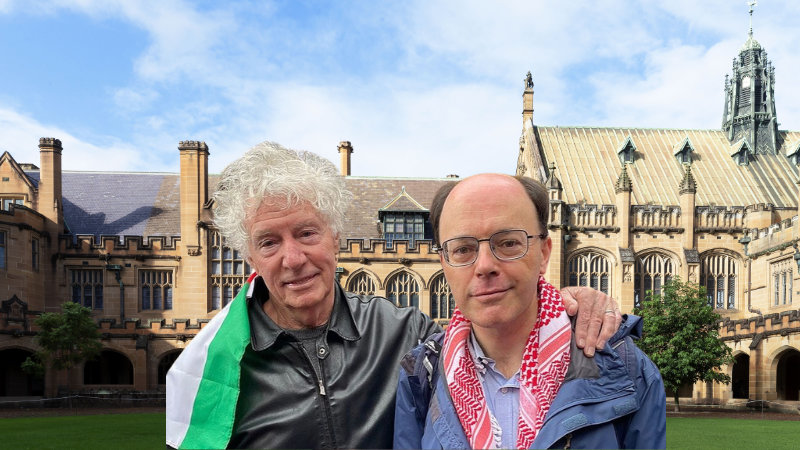

University of Sydney’s appointment of pro-Israel academic Michael Abrahams-Sprod as antisemitism adviser has exposed management to an embarrassing conflict in its approach to freedom of expression. Wendy Bacon reports.
While antisemitism adviser Michael Abrahams-Sprod works in the Vice-Chancellor’s Mark Scott’s office as its “resident expert” delivering training courses to stamp out what he sees as antisemitism, his close colleagues in the Australian Academic Alliance Against Antisemitism are embroiled in legal action against the University in the Federal Court.
They have accused the University of being liable for alleged racial vilification by its employees, Professor John Keane and linguist and Vice President of the USyd National Tertiary Education Union, Dr Nick Riemer, both of whom are pro-Palestinian.
The case will have significant implications for freedom of speech
and whether the law equates rejection of Israel’s genocide and anti-Zionism to antisemitism.
Conflicts of interest and the 5A
Although Abrahams-Sprod is not a party to the case, he was a driving force behind complaints that led to the case, and letters that he signed are being used as evidence against the University.
Sydney Uni appoints antisemitism ‘lecturer’, forgets to tell anybody
Alongside its academics, the University is defending the action. So far its case depends on an interpretation of antisemitism that is in direct conflict with the views of 5A and Abrahams-Sprod, who is already teaching his courses for frontline administrative staff, some of whom deal with complaints against students and staff.
Three of five applicants in the court case are members of 5A. One is Emeritus Professor Suzanne Rutland, a longtime close colleague of Abrahams-Sprod. Rutland is on the Board of Australian Academic Alliance Against Antisemitism (5A) of which Abrahams-Sprod was campus coordinator between November 2023 and February 26 2025, and remains a member.
She is also on the Board of the International Holocaust Remembrance Alliance. Another complainant belongs to the pro-Israel Australian Jewish Association of Students, which Abrahams-Sprod assisted in making complaints.
According to 5A, anti-Zionism is antisemitism.
Its extreme views are revealed in parliamentary submissions, including one for the Inquiry into measures to prohibit slogans that incite hatred, which was co-authored by Rutland.
Conflating antisemitism with anti-Zionism
5A’s submission recommends prohibiting a wide range of slogans that are regularly used at pro-Palestinian protests. For example, it lists “Settlers, settlers go back home! Palestine is our home!” as a call for genocide of Israelis, and
accusations that Israel is causing ‘starvation’ in Gaza as a genocidal libel.
It supports a dangerous notion of “cumulative harm” that would see police trained to understand that protests or slogans that individually might appear lawful if repeated can become unlawful intimidation. It recommends a new agency to operate a “centralised, anonymous complaints system to capture antisemitic incidents, chants, symbols, and patterns of conduct, including behaviour that may not individually meet prosecution thresholds.”
Its clear goal is to silence opposition to Israel’s genocide, apartheid and other war crimes.
In contrast to 5A’s views, USyd’s lawyers, led by Robert Dick SC have argued in the Federal Court that anti-Zionism is not antisemitism. In fact, they have even relied on a letter to Overland journal signed by more than 50 Jewish academics and current students, repudiating “the attempt by those making the complaint to conflate Zionism, a political ideology with Jewish and non-Jewish adherents, with Jewish identity.”
Campaign to silence
The complaints against Riemer and Keane were part of “concerted and coordinated efforts to silence critics of Israel across Australia’s university campuses and public squares, trammelling fundamental democratic rights of assembly, protest, expression, and dissent”, they wrote.
At the time when USyd’s submissions were filed last year, unbeknownst to staff, the University was already covering part of Abrahams-Sprod’s salary to work with Special Envoy Jillian Segal on a project developing antisemitism training.
Abraham-Sprod took up his new two-year position in the Vice-Chancellor’s office in January, although it was not approved by the Senate’s People, Culture and Safety Committee until late March.
MWM asked the university:
“Did the Senate Committee discuss the issue of whether there could be a conflict of interest in appointing Abrahams-Sprod to work with the Vice-Chancellor on anti-semitism training?
“Does the university agree that there is a perceived conflict of interest? And if so, why did the University proceed with the appointment?”
In response to questions from MWM, a University spokesperson (we requested a name but were not given one) declined to disclose confidential committee discussions and stated:
“Dr Abrahams-Sprod will provide advice and perspectives rather than being involved in decision-making on issues relating to antisemitism, and so we don’t consider there to be a conflict of interest.
“His work will complement other University initiatives aimed at maintaining a civic environment that supports academic freedom and freedom of speech, while ensuring a safe and inclusive campus for all.”
It would seem from this response that the University understands that there is a potential conflict but avoids it by separating ‘influence’ from ‘decision making’.
Like all jobs, Abrahams-Sprod’s position will involve decision-making as well as influencing others’ decisions. The response undercuts the University’s description of Abrahams-Sprod as possessing ‘unique qualities’ and being the ‘resident expert’.
Israel lobby’s long-term funding of Uni
Few, if any, Australian humanities departments have been so generously funded by private interests as USyd’s field of Hebrew, Biblical & Jewish Studies.
In part one, we reported that Abrahams-Sprod’s lectureship is funded by Roth family foundations, which include John, who is married to the Special Envoy to Combat Antisemitism, Jillian Segal, and Charmaine and Stanley Roth, a leading Zionist fundraiser who died in January this year.
Further investigation reveals an astonishing integration of Hebrew, Biblical & Jewish Studies with the pro-Israel Zionist establishment of Sydney.
The Department always partnered with the Jewish Higher Education Fund (JHEF), which is a registered charity. Stanley Roth was a Trustee of JHEF since it was established in 1981.
The ACNC website lists the address of the charity as the Department at Sydney University, but its email contact is pwertheim@ecaj.com.au. Peter Wertheim is the co-CEO of the Executive Council of Australian Jewry.
He has chaired the fund since 1997, along with many other duties, including Chair of the Jewish Board of Deputies (1996-2000). and Co CEO of ECAJ (2009 -2026). The JHEF is one of the organisations that are supported by the Jewish Communal Appeal, of which Jillian Segal was recently elected a director.
In 2018/19, the Department and JHEF produced a report in which it acknowledged that “it’s only due to [the fund’s] generosity that we can plan for the future growth and development …”. The report stressed the importance of the Department’s work in combatting “polemical attacks against Israel’s legitimacy as a nation state” and “falsification of Jewish history, including calls for the BDS” to maintain “integrity of discourse about Israel and the Jewish people.”
The report celebrated the Department’s achievements in stitching Australia into the International Holocaust Remembrance Alliance (IHRA) and its definition of antisemitism.
The money flow
The Funds flow as needed with JHEF making annual contributions of between $450,000 and $700,000 covering lectureships, casual teaching staff and administration costs, and links with Israeli universities.
The Department thanked their donors “without which the department would have no future,” including the Pratt Foundation, the Roth Family and the Isaac and Susan Wakil family foundation. The Wakil Foundation is amongst the most generous donors in the history of USyd, providing more than $66 million for health buildings and scholarships, apart from smaller amounts contributed to Abraham-Sprod’s department.
MWM is not suggesting that there is anything wrong with private philanthropy, which is highly valued in the context of diminishing public funds.
Michael Abrahams-Sprod has a strong teaching record.
But is a person whose academic career has depended on some of Australia’s most powerful Zionists an appropriate choice for a ‘resident expert’ tasked with embedding interpretations of anti-Semitism that the university itself argues threaten academic freedom?
Academic freedom at stake
NSW Council for Civil Liberties President Tim Roberts says, “Abrahams-Sprod’s appointment is another example of employment procedures being used across our community to silence political communication.
By employing an advisor with such a “partisan perspective”, the university undermines community confidence that any conduct proceedings will be undertaken in good faith and without an apprehension of bias. This should be intolerable for any academic institution,” he said.
No one can deny that there is racism on campus, including Islamophobia, First Nations racism and antisemitism. Pro-Israeli students and staff are undeniably upset by pro-Palestinian activity. But 5A’s intentions are to silence pro-Palestinian activism.
In fact, some argue that nationalistic Zionism is itself a form of racism.
What about Arabic background staff and students who feel upset by USyd’s privileging the views of 5A academics about antisemitism before any anti-racism framework has been developed?
Abrahams-Sprod is training staff to exercise administrative power, which can have big consequences, although it is often hidden and very hard to challenge.
According to USyd, Abrahams-Sprod will “consult with all relevant communities and stakeholders in his work as special advisor”. But what does this mean when the courses are already underway without two big stakeholders – the Student Representative Council or the NTEU – even being consulted?
The SRC opposes the appointment. SRC Vice-President and co-covenor of Students for Palestine, Shovan Bhattarai, says it will “entrench a trend towards more authoritarianism” against hundreds of students who are “supporting campaigns against the university’s complicity in genocide.”
Protests are still permitted but the university must be notified as soon as they are announced. Posters and banners are banned except in designated spaces. Anything less than full compliance can lead to disciplinary action, which students are forbidden to speak about publicly.
Censoring links to MWM and Overland stories
At an online staff ‘Townhall’ on March 2, there was more support for discussion about antisemitism training than any other topic. Afterwards, Honi Soit reported that Riemer and historian Dr David Brophy, both members of University of Sydney Staff for Palestine, posted very brief comments and links on the staff internal platform.
Neither were informed when their posts were quickly removed. Riemer expressed his concern that the training could stigmatise Palestinian staff and students, and linked his post to this MWM story. Brophy published a link to an article he wrote for Overland journal.
Anonymous censors at USyd are preventing any collective staff discussion of compulsory antisemitism training. And also preventing any discussion of the fact that they’re censoring this discussion. https://t.co/HYdYIxpA8N
— David Brophy (@Dave_Brophy) March 27, 2026
.
They were found to have posted material “reasonably perceived as inflammatory or having the potential to incite others, including other users” – a finding which they vehemently reject as interfering with their academic freedom. Riemer’s complaint against this treatment was dismissed.
The university refused to identify the decision-makers.
A disturbing exercise of hidden power, but an undoubted win for the 5A approach and the Zionist funders.
Wendy Bacon is an investigative journalist who was the Professor of Journalism at UTS. She worked for Fairfax, Channel Nine and SBS and has published in The Guardian, New Matilda, City Hub and Overland. She has a long history in promoting independent and alternative journalism.
She is a long-term supporter of a peaceful BDS and the Greens.