
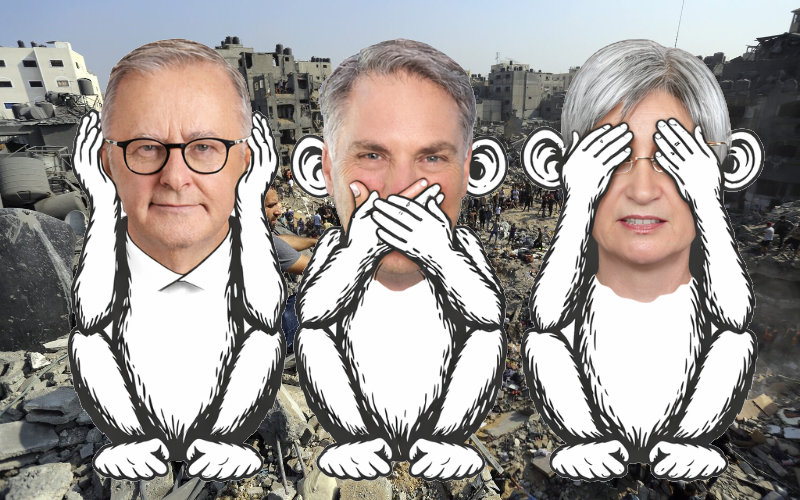
There is a bitter truth that must be spoken before we can talk honestly about what is happening to us now. Andrew Brown on Australia’s quiet complicity in the illegal US-Israeli war on Iran, fourth in a series.
When the bombs fell on Gaza, Australia was quiet.
When the hospitals were destroyed, when the aid was blocked, when children were pulled from rubble in pieces, when the United Nations, the International Criminal Court, and humanitarian organisations with decades of credibility in conflict zones used words like genocide, ethnic cleansing and collective punishment, Australia was quiet.
Not uniformly. Not entirely. There were protests in every major city, sustained over months, of a size and seriousness this country has not seen since the Iraq War.
There were independent senators who stood in Parliament and said what needed to be said, in plain language, without diplomatic hedging. There were journalists, academics, former diplomats, and hundreds of thousands of ordinary Australians who signed petitions, marched in the streets, and wrote letters that went largely unanswered.
Palestinian-Australian, Muslim-Australian, Arab-Australian communities, and many others with no personal connection to the conflict beyond a functioning conscience, screamed into a political void and were told, in effect, to calm down.
Or apprehended for wearing a t-shirt.
Police rush Bondi Beach, apprehend ‘F … Israel’ tee-shirt man … again
The country, as a political entity, its government, its major institutions, its official voice to the world, was quiet.
The cost of silence
That silence had a cost. Not just a moral cost, though the moral cost is staggering and will take generations to fully reckon with. A strategic cost. The cost of allowing a logic of unchecked military impunity to establish itself as the operating principle of the US-Israeli alliance. A logic that, once normalised in Gaza, did not stay in Gaza.
It never does.
Over 72,000 people killed so far. Over 171,000 injured. An entire civilian population, in one of the most densely populated places on earth, was systematically starved, displaced, and destroyed.
Journalists were killed in numbers that constitute, by any honest accounting, a deliberate campaign to eliminate witnesses. Paramedics were bombed. UN peacekeepers were struck. Aid workers from Australia’s own partner organisations were killed in strikes so precise they could not have been accidental.
Australia expressed concern.
Calibrated, diplomatically worded, operationally meaningless concern.
And then, when the same alliance, emboldened by eighteen months of zero meaningful consequence, turned its weapons on a sovereign nation-state, on Iran, on February 28 of this year, Australia expressed support. Called it constructive. Offered the American justification back to its own people as sovereign Australian policy.
Warnings ignored
The people warning loudest about Gaza were not merely warning about Palestinians. They were warning about a system. A system in which American military power and Israeli strategic ambition, freed from the constraints of international law and serious allied pushback, would expand. Would find new targets. Would come, eventually, for the stability of every country caught in its orbit.
They were right. And they were called antisemitic for saying so.
Iran did not come from nowhere. The assault on Iran is the direct and logical extension of the impunity normalised in Gaza. If you can destroy a civilian population with no meaningful consequence, you can bomb a sovereign nation.
If the ICC arrest warrant for Netanyahu means nothing, then international law means nothing. And if international law means nothing, then the only operating principle is force. And the consequences of force are distributed not just to the combatants but to every country whose government chose alignment over principle.
Australia chose alignment over the people of Gaza. It chose it again over Iran. And now it is discovering, at the bowser and the checkout and the business bank account, exactly what that choice costs.
The war came home
Here is what makes this moment different from every protest march and every unanswered letter that came before.
The pain is no longer abstract.
When Gaza burned, the average Australian, cocooned by geographic distance, insulated by a media that kept the most confronting images off prime time, reassured by politicians who described it as heartbreaking while doing nothing, could maintain the fiction that this was someone else’s tragedy.
Terrible, certainly. Distant. Manageable. Something that happened over there, to people over there, in a conflict that had been going on forever and would presumably continue
without any particular bearing on the school fees or the mortgage or the quarterly business figures.
That fiction is now dead.
The fuel price spike is not over there. The supply chain disruption is not over there. The investment uncertainty showing up in superannuation statements, in business loans that just got harder to service, in the job that exists today and may not exist in three months. None of that is over there.
The war came home. Not in body bags. Not in the specific grief of a military family. It came home in the way that imperial adventurism always eventually comes home to the countries that enable it. Through the economy. Through the slow, grinding, distributed punishment of a population that was never consulted, never warned, and never honestly told what their government’s choices would cost them.
Australia’s complicity
Australia was a participant in Gaza’s destruction. Not with weapons. Not with soldiers. With silence. With diplomatic cover. With the specific, material legitimacy that flows from a liberal democracy declining to formally object. And with the arms adjacent, intelligence and security cooperation that flows through Five Eyes and has never been seriously interrogated in the Australian public domain.
Six Eyes: Australia’s secret support for the Israeli assault on Gaza, through Pine Gap
Complicity is not passive.
When you have the power to intervene, to sanction, to condemn, to withdraw diplomatic cover, and you choose not to, you are not a bystander. You are a participant. And participants, eventually, share in the consequences.
The Palestinian people could not make Australia listen with their suffering alone.
Not because Australians are cruel. They are not. But because the suffering was made distant. The media made it complex. The politicians made it delicate. The lobby groups made it professionally dangerous to say in plain language what was plainly happening.
The whole architecture of managed consent did its job with brutal efficiency for eighteen months.
But a forty percent fuel price increase cuts through managed consent, as does a wave of small business closures. And young Australians told to absorb the economic consequences of a war their government endorsed without their knowledge or consent. That cuts through everything.
The people who protested Gaza, who were dismissed and belittled and accused of antisemitism and told they were being naive about geopolitical complexity, understood something that the political class is only now beginning to grasp: That the world does not offer permanent non-involvement. That the wars you enable reach you. That the impunity you excuse comes back denominated in currencies you understand personally.
Fuel. Food. Jobs. Mortgages. Businesses. Futures.
This is that reckoning. The genocide in Gaza did not wake Australia up, the bill for enabling it will.
And when Australia wakes, fully, clearly, with the focused fury of people who now understand exactly what was done to them, the politicians who called it constructive and the media that told them to blame the Energy Minister are going to find that managed consent has a shelf life.
That shelf life has expired.

Andrew Brown is a Sydney businessman in the health products sector, former Deputy Mayor of Mosman and Palestine peace activist