
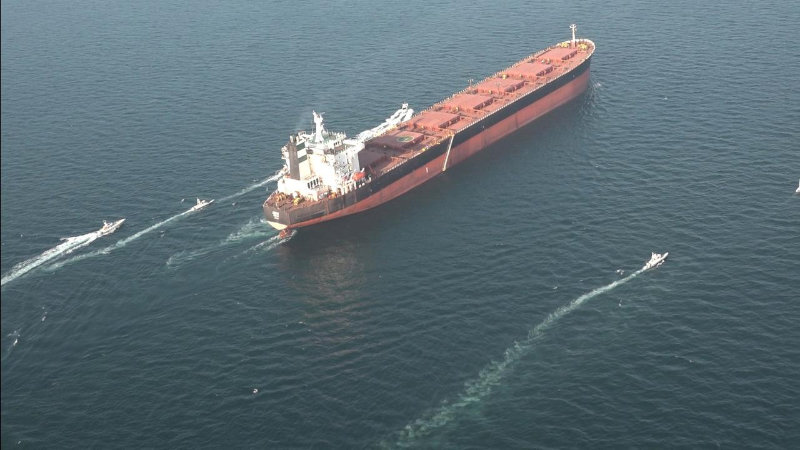
With the consequences of fuel disruption severe, neither Labor nor the Opposition can be trusted to tell the truth about our dwindling fuel reserves. Rex Patrick checks the facts.
In 2002, Australia (under Howard) held over 300 days of fuel stock. In January 2010 (Rudd), Australia had 83 days. In January 2012 (Gillard), Australia was down to 60 days, and in January 2015 (Abbott), we had just 51 days.
Last week, One Nation’s Barnaby Joyce asked a question of Minister Bowen in Parliament, “… how much diesel in days do we currently have in store on Australian soil?”
The minister responded, “The answer to the question is 34 days in relation to diesel …” and Barnaby rightly interjected, “With respect, I did say ‘on Australian soil…”
The Minister retreated, “I want to commend the member for the point of order. It’s a reasonable point of clarification. Those figures only include fuel in Australia or on ships in our economic zone.”
Barnaby was aware that the Government publishes on the internet ‘Diesel consumption cover days’ (total stocks in Australia at the end of the month, divided by average daily consumption of each fuel type for the previous 12 months).
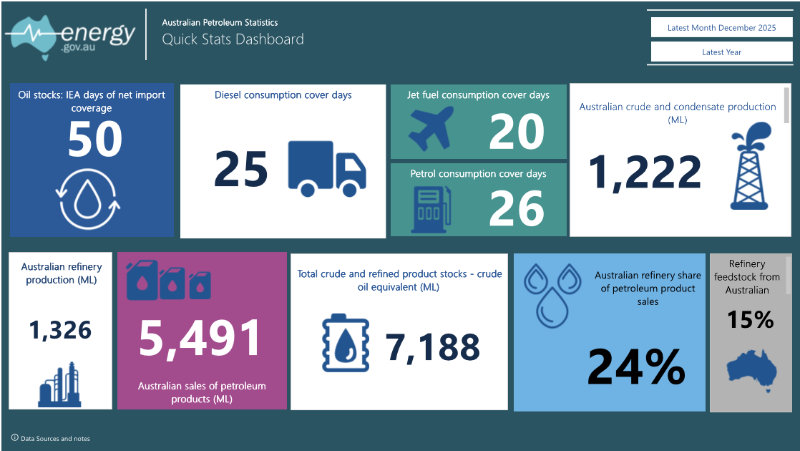
Published Petroleum Statistics (Source: Australian Government)
The 34 days quoted by Bowen were done to calm the public; to spin.
Long-standing neglect
In 2000, we had eight refineries. In 2003, the refinery at Port Stanvac in SA was closed. In 2012, the refinery at Clyde in NSW closed. In 2014, the refinery at Kurnell in NSW closed. In 2015, the refinery at Bulwer Island in Queensland closed. In 2021, the Kwinana refinery in WA and the Altona refinery in Victoria closed.
Regardless of which of the Uniparty was in charge, little was done to address the shortage.
From September 2014 to June 2015, the Senate conducted an inquiry into ‘Australia’s transport energy resilience and sustainability’, which predominantly focused on fuel security. Following the report of the Committee, the Turnbull Government initiated its own liquid fuel security review, which was kept secret until released as a result of a long FOI Fight in the Administrative Appeals Tribunal.
Fuel security. What happens if the bowsers start to run dry?
Flowing from the liquid fuel security review, the Morrison Government introduced the Fuel Security Bill 2021 into Parliament.
The Bill provided for a ‘Fuel Security Service Payment’ to the two remaining refineries to eliminate ‘downside financial risk’ when times are tough, to ensure the capability would remain.
The Bill also introduced a ‘minimum stockholding obligation’ on the industry to ensure a baseline level of key transport stocks at all times. The obligation was designed to see diesel stocks maintained at 2018-19 average levels (circa 22 days for diesel) starting in 2022 and then increasing by 40% (circa 32 days) by 2024.
To increase the storage capacity to achieve those increased diesel stocks, more storage was required, hence the Government agreed to co-invest in that storage through the Boosting Australia’s Diesel Storage Program (BADSP).
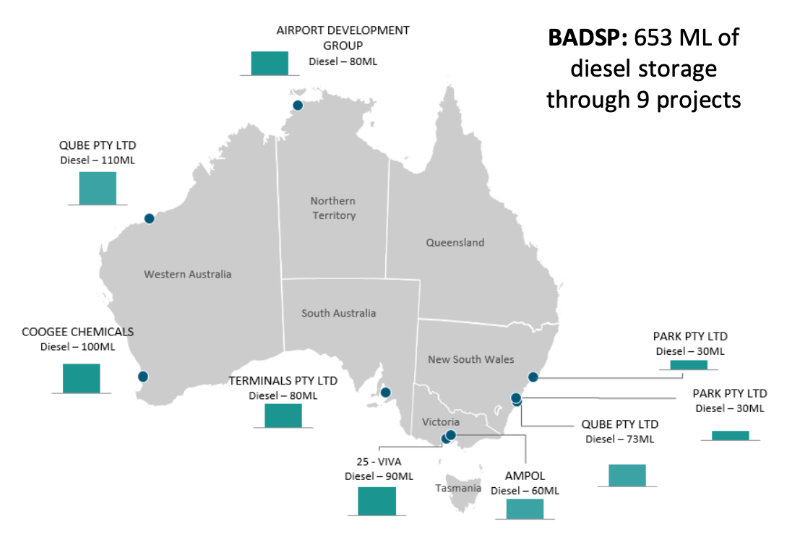
Boosting Australia’s Diesel Storage Program (Source: Government)
Additionally, in the March 2022 budget Government committed to having a Commonwealth-owned stockpile of technical-grade urea, used to reduce noxious emissions from diesel trucks, to maintain the security of Australia’s supply of diesel exhaust fluid. The current Government extended this program in the 2025/26 Mid-Year Economic and Fiscal Outlook.
With facts behind us, we can look to the politics playing out. As well as the spin.
Labor Playing Politics
Every day in this parliamentary sitting session, diesel shortages have been a topic of questions and debate.
Minister Bowen told the parliament that diesel stocks are “the highest they’ve been for any time in the past 15 years”. This has been repeated numerous times by other ministers in response to questioning, and by Labor MPs and senators during debate.
While it is true, we are talking about a few cover days. 25 days, as it currently sits, is higher than the typical 22 to 24 days, but the Government’s statement deliberately misleads listeners, at least the optimistic listeners, into thinking things are so much better under Labor.
And if politics were to be removed, Bowen would credit the Coalition for that achievement through the 2021 legislative changes and BADSP program.
Bowen also told the House, when talking about stockpiling, “… that’s why we introduced minimum holding stocks. This was work that was not conducted by the previous government”.
The last sentence is just plain wrong, and the first sentence misleading. The 2021 Fuel Security Act is the statutory source for the minimum stockholding obligation, but its commencement was always to be determined by rules that were to be developed after the passage of the Bill, and with regard to a transition for the industry. It came into effect on 1 July 2023.
Even more politics was played out on the floor of the House, with Bowen stating “the previous government (Abbott and Morrison) saw four out of six petroleum refineries close when they were in charge—four out of six close. The two that we inherited are still in operation. That is not because of an accident; it’s because of government and industry working together.”
A more truthful statement would have mentioned the closures of a refinery under the Gillard Labor Government and the fact that the ‘no accident’ was actually the Liberal’s 2021 ‘Fuel Security Service Payment’.
The spin (and we are being generous in using that word) is to serve two purposes – to calm the public and to bolster Labor’s political standing in an area where they have, on the facts, not performed well.
Strategic fleet
When the Fuel Security Bill in June 2021 was being debated in the House, Catherine King, now Minister for Transport, stated:
“What will be essential when things go wrong and when our fuel is too far away is a fleet of ships on which our nation can actually rely. An Australian-flagged strategic fleet is a key plank in assuring Australia’s fuel security and broader supply chain security. But this government is leaving it to languish. Over recent years, Australian shipping has all but collapsed. Over the past 30 years, the number of Australian-flagged vessels has shrunk from 100 to barely 10.”
Anthony Albanese went to the 2022 election with a promise to create a strategic fleet, and a ‘Strategic Fleet Taskforce’ was established when Labor came to Government with a report being handed down in June 2023.
However, there has been no movement. The strategic fleet is caught in the doldrums.
Coalition playing politics, too
Labor is not alone in playing politics.
Although the truth is that fuel supplies to Australia have not yet been disrupted, some fuel distributors and petrol outlets have run short. The cause is people’s forward purchasing of fuel to avoid higher prices that may come and/or to avoid real shortages.
It’s not a supply issue, rather an increased demand issue.
The Coalition have been capitalising on these shortages and hitting Labor in the parliament and media on it. It’s disingenuous.
The reality is that supplies are currently normal. But people are hoarding because of a lack of confidence in the major parties and a lack of confidence in our ability to withstand further shocks.
Truth absent from Parliament
The truth can’t be gleaned from watching the Parliament. We do need to be alert to fuel supply risk; there is real potential for problems in the near future as the Strait of Hormuz remains closed and fuel infrastructure across the Middle East is attacked.
The International Energy Agency has just announced the release of reserves held worldwide. That should help. Australia, which has failed to meet its 90-day reserve obligations, will not contribute.
There is no doubt that inadequate fuel reserves have contributed to a lack of public confidence and to fuel price hikes.
Both major parties are responsible for the tenuous situation we are in. Both have ignored the fact that our nation is vulnerable to fuel disruption and have instead focused on much ‘sexier’ capabilities like fighter jets, tanks and submarines (all of which require fuel). Both have failed to meet their national security and national resilience obligations.
We are currently investing tens of billions on submarines we are unlikely to receive and pouring money into the world’s most expensive frigates. One can only hope that the events of the past few weeks will cause a rethink and a fuel security remedy.
But maybe that’s just us here at MWM sniffing the petrol fumes.

Rex Patrick is a former Senator for South Australia and, earlier, a submariner in the armed forces. Best known as an anti-corruption and transparency crusader, Rex is also known as the "Transparency Warrior."