
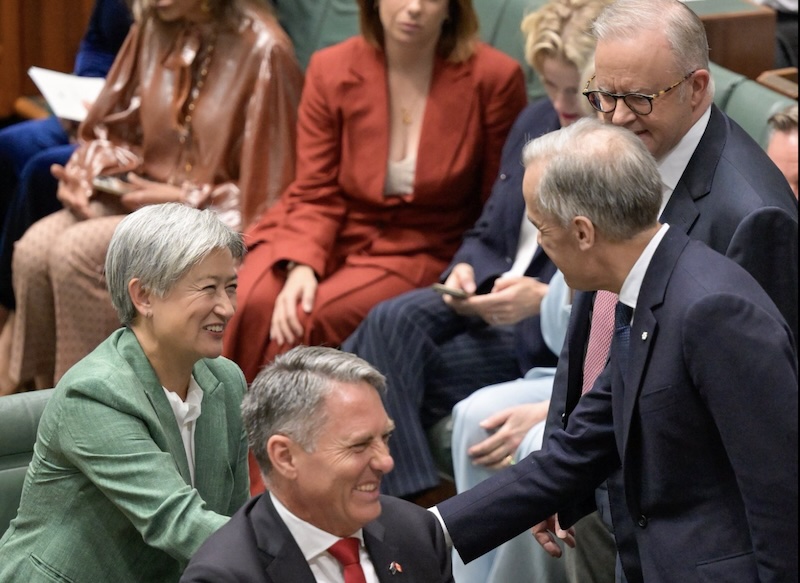
Australia claimed impotence over Gaza but is now sending military support to the US-Israel war in the Gulf. Andrew Brown on the hypocrisy of a nation that prides itself on fairness.
This week, Australia announced it would help defend the United Arab Emirates from Iranian attack.
A Royal Australian Air Force Wedgetail surveillance aircraft is being sent to the Gulf along with personnel and advanced defensive capabilities as part of a broader effort to help protect regional airspace.
Prime Minister Anthony Albanese framed the move as part of Australia’s responsibility to support international stability. Foreign Minister Penny Wong confirmed that Australia was considering requests from Gulf nations for assistance in defending themselves against Iranian missile and drone attacks.
Suddenly, Australia can project power deep into the Middle East.
Suddenly we can send aircraft.
Suddenly, we can send missiles.
Suddenly, we can speak in the language of security and moral clarity.
And suddenly the Middle East is not so far away after all.
Because for the past year, Australians were told something very different.
When Gaza was being destroyed, the message from Canberra was that Australia is merely a “middle power.” The conflict was distant. Complex. Beyond our ability to influence. There was little we could do.
Restraint became the official moral position.
The government said it.
The opposition echoed it.
Large sections of the media repeated it.
Anyone who argued that Australia should speak more forcefully about what was happening in Gaza was treated as naïve or ideological. The country was told that moral outrage had to be tempered by realism.
But while Australia practised this restraint, Gaza was being erased in real time.
Children were pulled from the ruins of apartment buildings that had collapsed under air strikes. Entire families disappeared beneath concrete slabs while neighbours dug through rubble with their bare hands.
Hospitals were bombed or besieged until their generators ran out of fuel. Surgeons performed amputations without anaesthetic. Premature babies died in incubators because electricity had failed.
Schools became shelters for displaced families.
Then those schools were bombed, too.
Entire classrooms disappeared in explosions. Teachers and children buried together beneath concrete and twisted steel.
Food vanished.
Aid agencies warned that famine was spreading. Children were starving. Mothers diluted formula because there was nothing left to feed their babies.
And amid the chaos came the reports that chilled even hardened war correspondents.
Doctors describing children arriving in emergency rooms with gunshot wounds to the head or chest. Small bodies carried through shattered hospital corridors after sniper rounds tore through them in the streets.
This was not propaganda. These were the testimonies of doctors, humanitarian workers and journalists on the ground.
This was Gaza.
Cowardice of ‘caution’
And how did Australia respond?
With caution.
For months, the political class repeated the same carefully constructed argument. The situation was complicated. Australia had limited influence. Strong action would achieve little.
Better to remain balanced.
Better to remain restrained.
The government hid behind diplomatic language.
The opposition, particularly the louder voices inside the Liberal and National parties, went further. They condemned protests, dismissed criticism of Israel as extremist and opposed humanitarian pathways for Palestinians fleeing the destruction.
In some cases, the rhetoric became openly hostile. Palestinian suffering was treated as a political inconvenience rather than a humanitarian catastrophe.
And much of the media followed suit.
Coverage of Gaza was often framed through the language of “complexity” and “balance.” Israeli security concerns were explored in depth, while Palestinian deaths were frequently reduced to statistics buried deep in reports.
Calls for sanctions or stronger diplomatic pressure were portrayed as radical or irresponsible.
Restraint became the narrative.
Heading to the Gulf
But now Australian aircraft are heading to the Gulf.
Now Australia can defend airspace thousands of kilometres away.
Now the Middle East is suddenly within our strategic reach.
It is difficult to imagine a clearer example of moral elasticity.
Yet the hypocrisy does not end there.
At the same time, Australia has moved quickly to offer protection to members of the Iranian women’s football team seeking asylum abroad. Several athletes have been granted humanitarian visas and welcomed with words of sympathy and concern.
And in principle, that is exactly the right response. People fleeing repression deserve protection.
But the contrast with Gaza is impossible to ignore.
When Palestinian families sought refuge from bombardment and starvation, the tone from Canberra was very different. Politicians warned about security risks. The opposition condemned proposals for humanitarian visas. Sections of the media amplified fears about migration.
Compassion was suddenly conditional.
The same political voices now urging protection for Iranian athletes were among the loudest critics of offering refuge to Palestinians fleeing bombs and famine.
Apparently, some victims deserve asylum.
Others deserve suspicion.
And the media cannot pretend innocence in this performance.
When Iranian repression or attacks on Gulf states dominate the headlines, the language of moral clarity suddenly returns. Victims are humanised. Outrage is expressed. The responsibility of democratic nations to respond is emphasised.
Hierarchy of suffering
But when Palestinian civilians were buried beneath rubble, when hospitals collapsed and children starved, the dominant tone was caution.
One conflict is analysed with restraint.
The other with urgency.
Together, the political class and large parts of the media construct a quiet hierarchy of suffering.
Some lives command outrage.
Others barely command attention.
And that raises an uncomfortable question for a country that prides itself on fairness.
Australia loves to imagine itself as egalitarian. The land of the fair go. A nation that instinctively sides with the underdog. But myths have a habit of collapsing when they collide with reality.
And the reality is this:
When Gaza’s children were starving, when hospitals were collapsing, when entire families were buried beneath rubble, Australia did not speak with moral clarity; Australia spoke with caution.
When Gulf allies asked for military assistance and Iranian athletes sought asylum, suddenly, the language of principle returned, and Australia found its voice.
The truth is painfully simple. Canberra was never powerless; it was simply selective.
And when compassion appears only when it suits our alliances, our politics or our convenience, it stops being compassion at all. Instead, it becomes theatre.

Andrew Brown is a Sydney businessman in the health products sector, former Deputy Mayor of Mosman and Palestine peace activist